
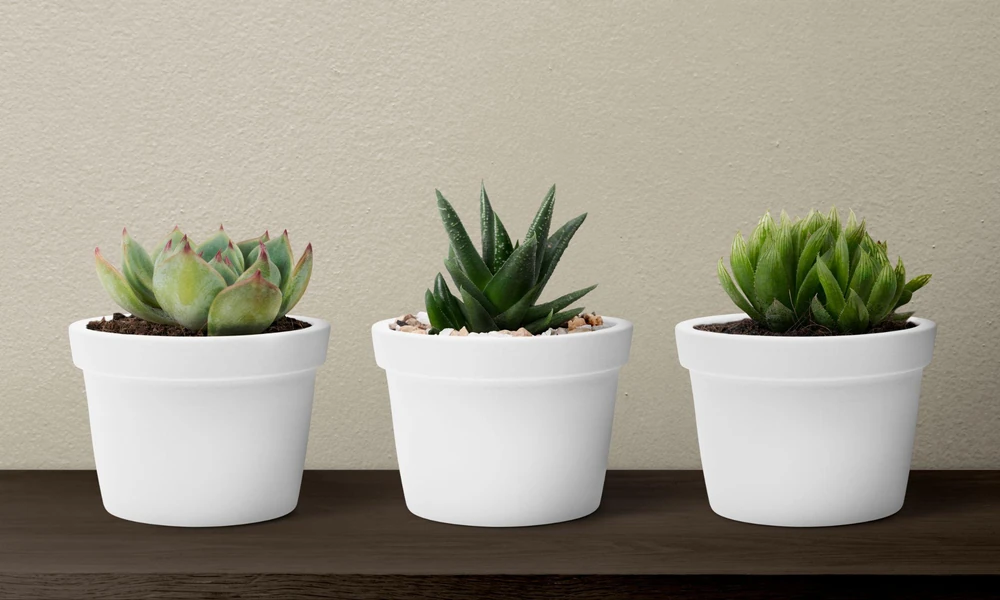

Succulents store water in their leaves, stems or roots, which allows them to tolerate periods with limited moisture. However, they can still be affected by both insufficient and excessive watering. Learning to distinguish these conditions helps prevent avoidable problems and supports consistent plant care.
Watering needs vary according to factors such as the plant’s growing environment, soil, container and light levels. This is particularly relevant when caring for a succulent plant in Singapore, where humidity and indoor conditions can affect how quickly growing media dries.
How Can You Tell When a Succulent Needs More Water?
A succulent that lacks sufficient water may show changes in its leaves and overall structure. These signs should be considered alongside the condition of the growing medium rather than treated as a watering schedule on their own.
Common signs of insufficient water include:
- Wrinkled or shrivelled leaves: Leaves may lose their usual firmness as stored water is depleted.
- Leaves becoming thinner: A succulent may appear less full when its water reserves decline.
- Drooping or reduced firmness: Leaves and stems can become less rigid during periods of insufficient moisture.
- Dry growing medium: Soil that remains dry beyond the plant’s normal watering interval can indicate that watering is required.
Some older leaves may naturally dry out and fall from the plant as part of normal growth. Therefore, a single dry leaf does not necessarily indicate that the succulent needs more water.
The key point is to consider the plant’s appearance together with the moisture level of its growing medium. If the soil is dry and the plant is also showing several signs of dehydration, watering may be appropriate.
How Can You Tell When a Succulent Has Been Overwatered?
Overwatering occurs when a succulent receives excessive moisture or its growing medium remains wet for too long. Succulents generally require well-drained conditions because prolonged moisture around the roots can contribute to root damage and rot.
Signs that may indicate excessive watering include:
- Yellowing leaves: Leaves may turn yellow when the plant is experiencing problems associated with excess moisture.
- Soft or mushy leaves: Healthy succulent leaves generally have a firm structure, while water-damaged tissue may become unusually soft.
- Translucent leaves: Some succulents develop leaves that appear unusually swollen or translucent when affected by excess water.
- Leaves dropping easily: Widespread leaf loss combined with wet soil can indicate a watering problem.
- Persistently wet soil: Growing media that remains wet for an extended period can indicate inadequate drainage or excessive watering.
Overwatering can sometimes be confused with underwatering because both conditions can cause changes in leaves. Checking the soil and drainage is therefore important before adding more water.
Remember, for a succulent plant in the city-state, indoor humidity, ventilation and air conditioning can influence how quickly the growing medium dries. The plant should therefore be assessed according to its actual growing conditions rather than a fixed watering rule.
How Do You Check Whether a Succulent Needs Water?
Checking the growing medium before watering is one of the simplest ways to avoid unnecessary watering. The surface may appear dry while moisture remains lower in the pot, so checking beyond the top layer can provide a more useful indication.
- Check the soil: Feel the growing medium below the surface to determine whether it is still moist.
- Inspect the leaves: Look for consistent signs such as wrinkling, shrivelling, unusual softness or yellowing.
- Check the container: Ensure the pot has drainage holes that allow excess water to escape.
- Look for standing water: Empty excess water from saucers or outer containers rather than allowing the pot to sit in water.
- Consider recent watering: Avoid watering again simply because several days have passed if the growing medium is still moist.
A florist in Singapore may also provide care information when supplying a succulent, particularly where the plant’s growing medium, container and growing requirements are known. However, the plant’s current soil condition remains important because watering needs can change after a move or change in the indoor environment.
Once the soil and plant have been checked, the next consideration is how frequently watering should take place.
How Often Should You Really Water a Succulent?
There is no universal number of days that applies to every succulent. Watering frequency depends on the plant species, pot size, growing medium, drainage, light, temperature and surrounding humidity.
Instead of following a strict calendar, use the condition of the plant and soil as indicators. A practical approach is to:
- Check the growing medium before watering.
- Assess whether the plant shows signs of dehydration or excess moisture.
- Water when the growing conditions indicate that moisture is needed.
- Allow excess water to drain away.
- Check the soil again before the next watering.
Seasonal and environmental changes can also alter how quickly soil dries. A plant kept in a bright, well-ventilated location may have different watering requirements from one kept in a humid or poorly ventilated space.
The main principle is to avoid both extremes. Succulents need access to water, but allowing the growing medium to remain excessively wet can create conditions that are unsuitable for healthy roots.
Contact D’Spring and gain practical guidance on choosing and caring for plants suited to your indoor environment.
