
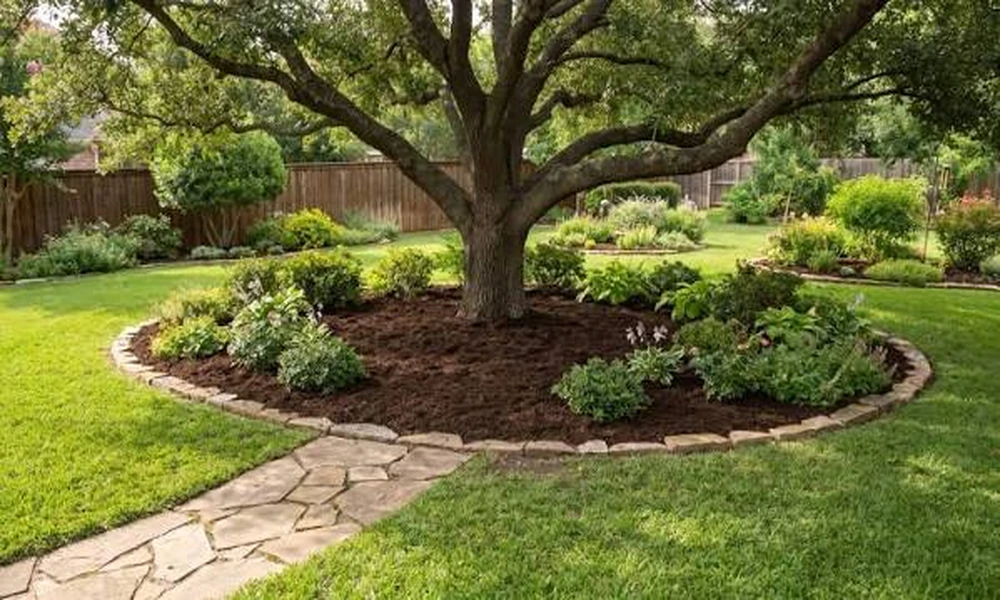

A mature tree can provide shade and character that new plantings will take years to develop. If you want to keep it during a landscape project, plan around its roots and canopy from the beginning. Patios, grading, irrigation, and construction access can all affect its health.
That is where thoughtful design makes the difference. In Utah, where heat, freeze-thaw cycles, and uneven soils all affect plant performance, mature trees should be treated as fixed assets in the plan, not obstacles to work around. The most successful projects preserve the value of the tree while creating new outdoor space that feels intentional, durable, and easy to maintain. Cottonwood Landscapes approaches that balance as part of a broader design-build process that considers both structure and planting from the start.
Why Mature Trees Should Shape the Design, Not Just Survive It
A landscape built around existing trees is not a compromise. Done well, it is often the stronger design because the trees already bring scale, shade, and character. The challenge is that their benefits come with constraints. The root system may extend far beyond the trunk line, and heavy excavation, compacted soil, or poor drainage can quietly damage the tree long before symptoms appear.
The best designs begin with the assumption that the tree is part of the site’s structure. That changes the placement of patios, retaining walls, beds, lighting, irrigation, and circulation paths. Instead of forcing a tree to fit a generic plan, the plan should respond to the tree’s canopy spread, root sensitivity, and seasonal conditions. That is especially important in Utah landscaping, where the same yard may need to handle dry summers and winter soil movement in a single year.
A mature tree also affects how the rest of the yard feels. Under deep shade, turf may struggle. Near exposed roots, grade changes may be limited. Close to the trunk, even small design mistakes can have long-term consequences. Thoughtful planning prevents those problems before they become expensive repairs.
Start With What the Tree Already Needs
The first mistake many landscape plans make is treating the area under a mature tree like blank ground. It is not blank. It is a living system with a distinct microclimate. Soil moisture, root density, sun exposure, and air movement all change around the tree, and those factors should drive the design.
Map the Root Zone Before You Draw the Layout
The root system is usually broader than people expect. That means the practical work area may be larger than the visible canopy line suggests. Before placing hardscape or major planting beds, the design should identify where roots are likely concentrated and where excavation must stay shallow or minimal.
This does not mean you cannot build near a mature tree. It means the build should be disciplined. Narrow footpaths, perched beds, and carefully placed borders can preserve more of the root system than large-scale digging. Cottonwood Landscapes is well suited to this kind of work because its process integrates design, excavation, and construction instead of treating them as separate decisions.
Read the Shade, Soil, and Water Conditions Together
A mature tree creates shade, but shade is only one part of the picture. The canopy can reduce evaporation, the roots may compete with nearby plants for moisture, and the soil under the tree may drain differently from open lawn. In some yards, the area beneath the canopy is drier than expected. In others, irrigation runoff and poor grading create too much moisture in one spot.
That is why plant selection and drainage planning need to happen together. A beautiful planting bed can fail quickly if it is installed in the wrong moisture zone. Likewise, a tree can be stressed if irrigation is designed without considering where its roots actually benefit from water and where they do not.
Build Around the Tree Without Building Against It
Once the site conditions are clear, the next step is deciding what should happen near the tree and what should be moved farther away. The goal is not to avoid all construction. The goal is to reduce unnecessary disturbance and make every feature earn its place.
A strong plan usually relies on a few principles:
- Keep major excavation away from the most sensitive root areas whenever possible.
- Use shallow-grade solutions near trees instead of deep cuts.
- Choose permeable or low-disturbance surfaces where soil health matters.
- Avoid piling fill soil against the trunk flare.
- Design drainage so water moves away from problem areas without starving the tree.
- Use plantings that can tolerate the canopy’s light and moisture conditions.
These decisions matter because a landscape succeeds or fails as a system. A patio that looks great but suffocates roots is not a good trade. Nor is a planting bed that wins on day one but creates long-term maintenance problems. Cottonwood Landscapes emphasizes that kind of integrated thinking because the work has to hold up through both seasonal change and real use.
Hardscape Placement Should Be Deliberate
Paver patios, flagstone walks, and retaining walls can all work around mature trees, but only if they are located and detailed carefully. Large impervious surfaces near trees can reduce water infiltration and increase heat around the root zone. On the other hand, a well-placed path can protect compacted soil by guiding foot traffic away from sensitive areas.
The best hardscape is not just visually balanced. It is technically appropriate. In Utah, that means accounting for freeze-thaw cycles, soil movement, and drainage from the outset. A decorative edge that shifts in winter or blocks root respiration is not a minor flaw. It is a sign the plan was too rigid.
Softscaping Should Support the Tree, Not Compete With It
Under and around mature trees, softscaping should be chosen with restraint. Low-profile perennials, mulched beds, and xeriscaping strategies often make more sense than turf that struggles for light and water. The point is to create a finished landscape that complements the tree’s conditions instead of fighting them.
That does not mean every tree bed has to look sparse. It means plant material should be matched to the site, not forced into a standard palette. Texture, seasonal color, and spacing can still create depth. The difference is that the design respects the tree’s existing influence on the site.
The Best Projects Solve for Durability, Not Just Appearance
A mature tree landscape should look good on installation day, but that is only the beginning. The more important question is whether it will still function after a few seasons of heat, irrigation cycles, and winter weather. Durable landscapes tend to share one trait: the structure and planting choices were made together.
Cottonwood Landscapes brings that kind of coordination to projects across the Wasatch Front, including Salt Lake, Utah, and Summit Counties. Their work combines design, hardscaping, softscaping, drainage, and planting in a way that is better suited to existing trees than a piecemeal approach. That matters because tree preservation is rarely just a planting issue. It is a grading issue, a drainage issue, and a construction issue too.
For homeowners who care about long-term value, that integrated approach is often the difference between a landscape that feels temporary and one that feels settled. It also helps avoid the common pattern where one contractor disturbs the site, another repairs the damage, and the final result never fully comes together.
What Smart Planning Looks Like in Real Life
Planning a landscape around mature trees usually comes down to a few smart moves. A patio may be shifted slightly to preserve the root zone. A planting bed may replace turf under dense shade. Drainage may be redirected so water reaches the right places instead of pooling near the trunk. A retaining wall may be rethought so it stabilizes a slope without forcing deep disturbance.
Those are not dramatic changes, but they are the kinds of choices that make a project successful. They also show why good design is not just about aesthetics. It is about judgment.
When a landscape is designed well, the tree looks like it was always part of the composition. The yard feels more usable, not less. And the homeowner gets a space that works with the property’s most valuable living feature instead of treating it as an inconvenience.
Cottonwood Landscapes can help turn that kind of planning into a finished outdoor environment that respects the trees you want to keep. If you are ready to think through the site correctly from the start, explore Utah landscaping with a team that understands how to build around existing trees with care and precision.
Planning a Landscape Around Mature Trees You Want to Keep
