
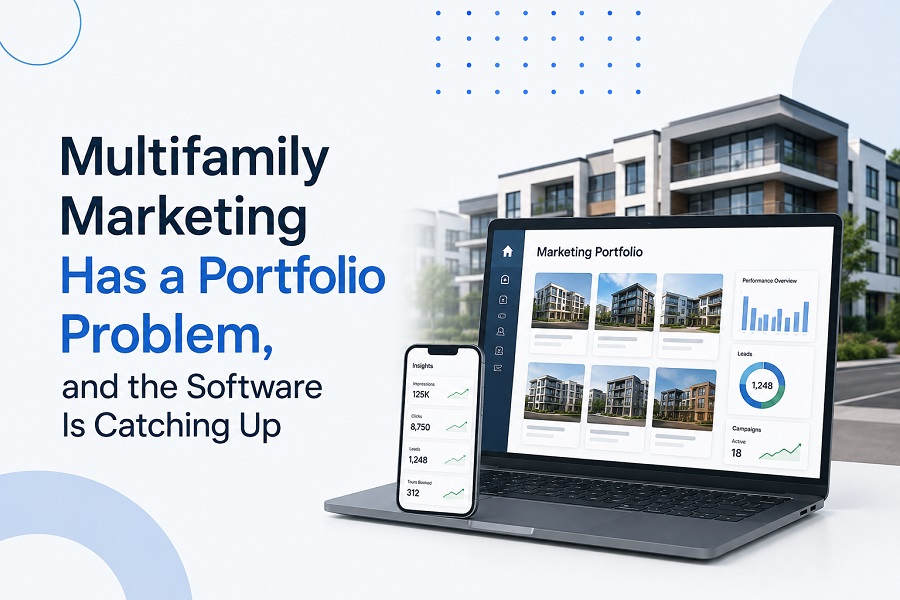

Here is an odd thing about multifamily. Operators think in portfolios. They finance in portfolios, staff in portfolios, report to investors in portfolios. Then the marketing gets built one building at a time: each property with its own website, its own availability page, its own contact form, its own little island of data. That’s manageable at three properties. At twenty it’s a maintenance burden, and at fifty it’s a filing cabinet pretending to be a digital strategy.
The renter never agreed to this structure
The person apartment hunting doesn’t care how the assets are organized. They want to know what’s available in their neighbourhood, under their budget, with two bedrooms, from anyone. When each building is its own silo, a prospect who strikes out at one property simply leaves, even if a sister building four blocks away has exactly the unit they described. The portfolio already paid to acquire that lead. The org chart of its websites threw the lead away.
Leasing teams feel the same fragmentation from the inside. Cross-selling between properties means knowing, off the top of your head, what’s open across a dozen buildings, or keeping a dozen tabs open and hoping none of them are stale.
What the vendors are starting to build
The interesting development is that multifamily unit visualization software, a category that has always been resolutely single-asset, is starting to treat the portfolio as the actual product. Planpoint, which builds interactive unit viewers for developers and property managers, published recent demo video of a feature it calls Groups: connect multiple buildings, multifamily or condo, into a single portfolio, and present the whole thing in one unified interactive hub. Renters and brokers browse real-time availability, floor plans and pricing across every connected property from a single link.
The operational translation is simple. One embed on the corporate site instead of a viewer per property page. One link for a leasing agent to send instead of five. One place where “what do we have right now” gets answered, for staff and prospects alike.
The objection, and why it’s weak
Some operators flinch at putting their own buildings side by side, since portfolio-level browsing invites comparison between them. The honest response is that the comparison already happens, just on Zillow and Apartments.com, where the operator controls nothing and pays for placement. If two of your buildings are going to compete for the same renter, better they do it on a page you own, where the loser of the comparison is still your lease.
Fragmented marketing was never a strategy. It was an accident of how the tools worked, one building at a time, because that’s all they could do. Now that the software can hold a whole portfolio in one view, the accident is optional.
