
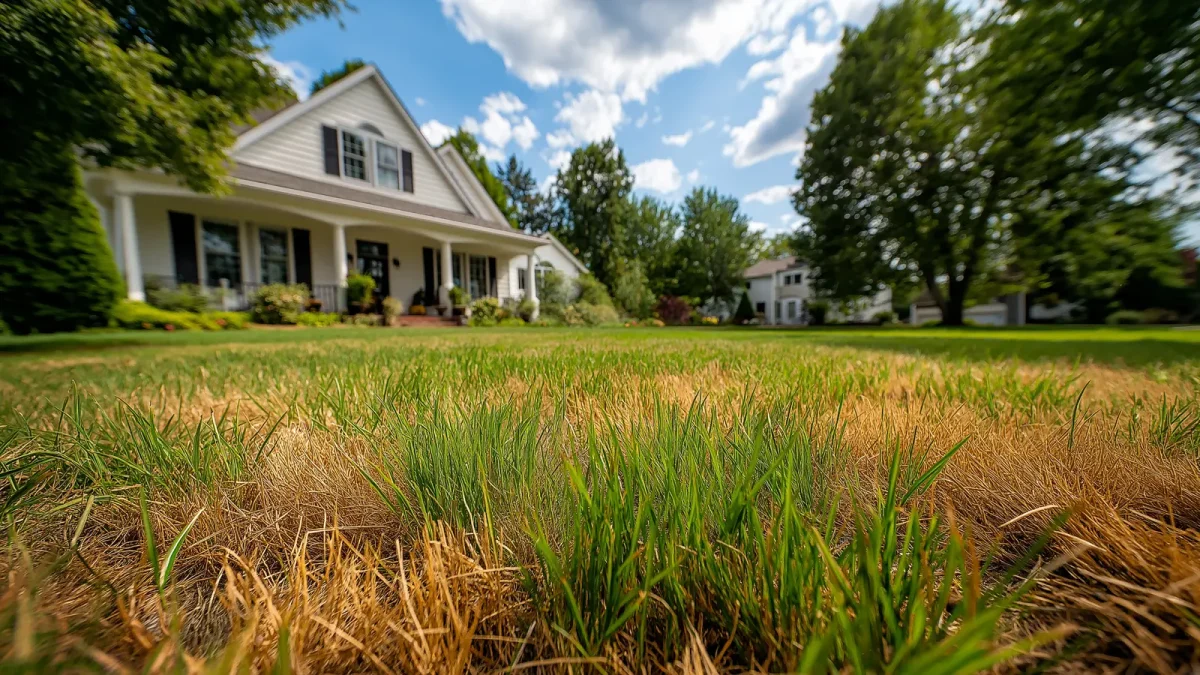

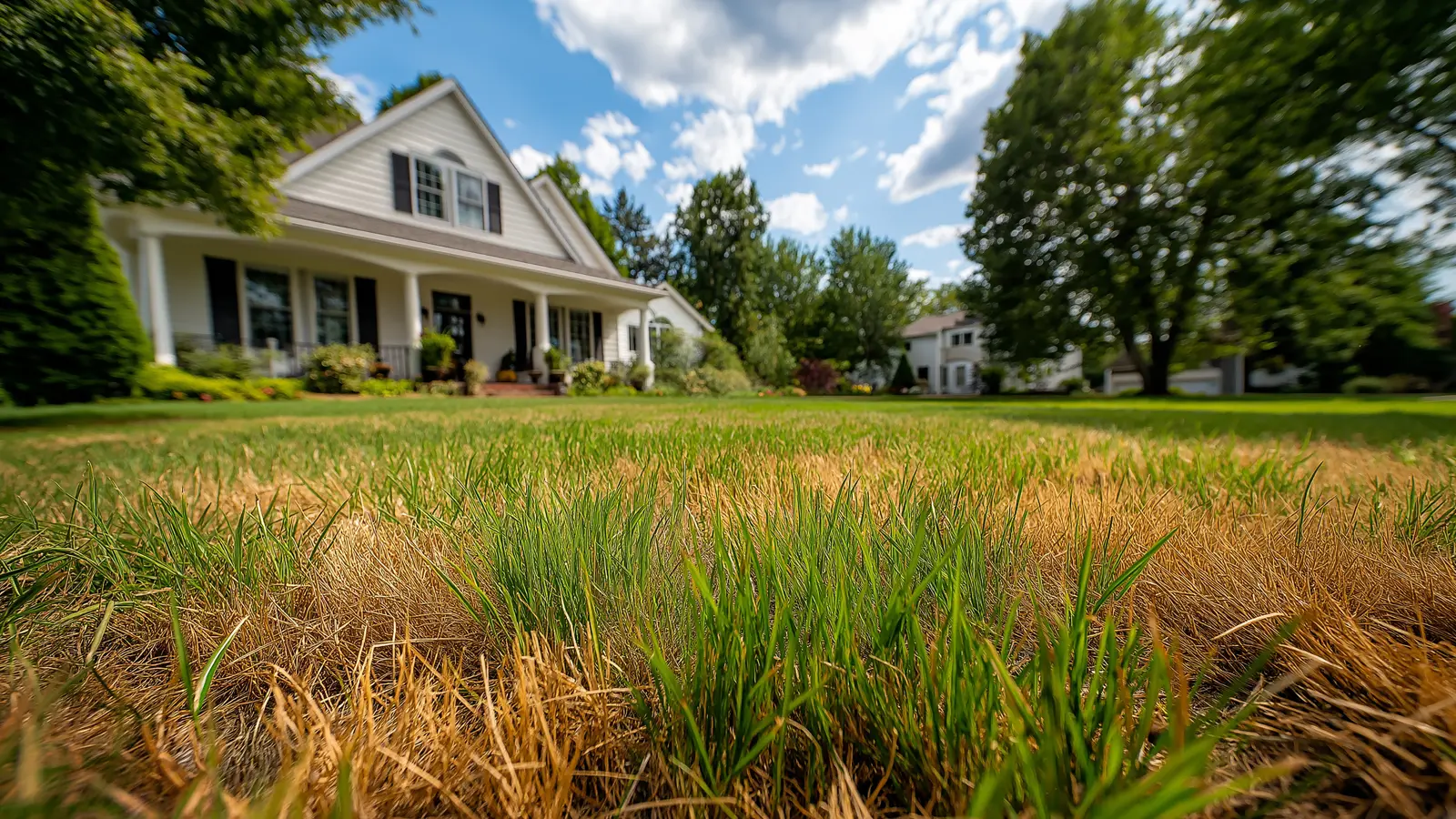
Plenty of Newtown homeowners do everything the bag says. They fertilize in spring, water when it is dry, and mow at a reasonable height. The lawn looks decent in April and May. Then July arrives, and something goes wrong. Patches thin out. The grass under the old oak trees turns yellow and refuses to recover. A wet week is followed by a dry stretch and the turf seems unable to handle either one. If that pattern sounds familiar, the problem is not your effort. It is that generic lawn care advice was not written for Newtown, CT, and the specific combination of conditions here breaks the standard playbook in ways that are predictable once you understand them.
Lawn care in Newtown CT requires accounting for clay-dominated soil, mature tree canopy coverage, and a Connecticut summer that alternates between drought stress and saturating downpours in ways that compound each other. None of those factors are unusual for Fairfield County, but each one requires a response that differs from what works in sandier, sunnier, or more consistently irrigated landscapes.
The Soil Problem That Most Lawn Products Cannot Solve
Fairfield County soils, including much of Newtown, run heavily toward silty clay loam and clay loam profiles. Clay soil has real advantages in theory: it holds nutrients and moisture well. In practice, clay in a residential lawn setting behaves like a sponge that has been compressed. After a season or two of foot traffic, mowing, and the simple weight of daily use, the particles compact together and the pore space that allows water and air to reach grass roots essentially disappears.
Compacted clay does two contradictory things that both kill turf. When it rains heavily, it sheds water as runoff rather than absorbing it, so grass roots sitting in the dry layer beneath stay dry even after a significant storm. When water does eventually penetrate, compacted clay drains slowly, keeping the soil waterlogged long enough to suffocate roots and create ideal conditions for fungal disease. This is why Newtown lawns develop dead patches after heavy rain as often as they do during dry spells.
Core aeration is the intervention that addresses this directly. A core aerator pulls plugs of soil out of the ground at regular intervals, opening channels that allow air, water, and fertilizer to reach the root zone rather than sitting at the surface. For compacted clay soils, fall aeration combined with overseeding is the single highest-return investment most Newtown lawns can receive. The plugs break down and help amend surface soil structure over time, and the open channels created by the tines remain effective through the following growing season.
Mature Trees and the Shade Problem That Intensifies Every Year
Newtown is a heavily wooded town, and many of its residential properties have mature oak, maple, and beech trees that have been growing for decades. The canopy coverage that makes a property beautiful in September is the same canopy coverage that is slowly expanding its footprint and changing what the lawn beneath it can realistically support.
Cool-season grasses like Kentucky bluegrass, which is the backbone of most established Newtown lawns, need a minimum of four to six hours of direct sun to maintain density. Below that threshold, the turf thins over time regardless of how well it is fertilized or watered. Homeowners often interpret this thinning as a soil or watering problem and respond with more fertilizer or more irrigation, neither of which helps. The grass is not stressed from lack of nutrients or water. It is stressed from lack of light, and no amount of lawn product addresses that.
The practical response in heavy shade areas is a species shift. Fine fescues, particularly creeping red fescue and chewings fescue, tolerate shade significantly better than bluegrass and perform well in Connecticut’s climate. Overseeding shaded zones with a fine fescue blend, rather than a general-purpose sun-and-shade mix, produces meaningfully better results in the long term. It is also worth accepting that the densest shade under a full-canopy mature tree may not support turf grass at any reasonable maintenance level, and ground covers or mulched beds are a more realistic long-term solution in those specific spots.
Connecticut’s Summer Rain Pattern and Why It Stresses Turf Differently Than Drought
Connecticut summers are not uniformly dry. They are unpredictable in a specific way: periods of moderate drought punctuated by heavy convective storms that drop an inch or more of rain in an hour. For a compacted clay lawn, this pattern is particularly damaging because the soil never finds an equilibrium. It goes from too dry to too wet and back again within the span of a few weeks.
Cool-season grasses, which is what most Newtown lawns are composed of, naturally go semi-dormant in the heat of July and August. This is normal and not a sign of disease or neglect. Dormant turf is not dead turf, and it will green back up when temperatures moderate in September. The mistake many homeowners make is trying to force the lawn out of dormancy during the summer stress period by heavily irrigating or applying mid-summer fertilizer. Both put the grass through a cycle of stressed growth at exactly the time of year when it is least capable of sustaining it.
A better strategy for summer is letting dormancy happen and protecting the crown of the plant rather than the blade. If you are irrigating, do it infrequently and deeply, roughly one inch per week in a single watering if possible, rather than light daily watering that keeps the surface moist but does not reach the roots. Raise the mowing height to three and a half to four inches during summer months. Taller grass blades shade the soil, reduce moisture loss, and protect the crown from heat stress in a way that shorter grass cannot.
Why Fertilization Timing Matters More Than Product Selection in Connecticut
The most common fertilization mistake in Newtown lawns is heavy nitrogen application in late spring or early summer. Nitrogen pushes blade growth, and pushing growth on cool-season grasses as summer heat builds forces the plants to support new tissue at exactly the point when their energy reserves should be building for the stress ahead. The result is lush growth in May followed by turf that is more vulnerable to summer disease, drought, and heat than it would have been with a more conservative approach.
The correct window for significant nitrogen application in Connecticut is early fall, roughly late August through October. At this point, soil temperatures have dropped enough that cool-season grasses are actively growing again, the stress of summer is behind them, and they have the remainder of fall to build root mass and carbohydrate reserves before going dormant for winter. A fall fertilization program that includes a slow-release nitrogen source, phosphorus if a soil test indicates deficiency, and potassium for winter hardiness is more valuable to a Newtown lawn than anything applied between June and August.
Professional Lawn Care in Newtown CT That Accounts for Local Conditions
The fixes for a struggling Newtown lawn are not complicated, but they require understanding the specific conditions at play: clay soil that needs mechanical intervention, shade situations that require species-appropriate overseeding, summer dormancy that should be managed rather than fought, and a fertilization calendar timed to Connecticut’s actual growing season rather than a national standard. Applying the right treatments at the right time produces results that generic seasonal programs consistently miss.
Tick & Turf provides lawn care in Newtown CT and throughout the surrounding Fairfield and New Haven County communities, including Southbury, Oxford, Brookfield, and Middlebury. Mike and the team offer fertilization programs, aeration and overseeding, and custom treatment plans built around what your specific property needs rather than a one-size-fits-all schedule. Call (203) 232-7285 or visit tickandturf.com to get a quote and discuss what your lawn actually needs heading into the fall season.
